Medable Agent Studio
Contributed design across Medable Agent Studio, the industry's first no-code agentic AI platform for clinical development. Led design for two of its earliest agents, the CRA Agent and the eTMF Agent, applying the platform's trust and compliance components, and extended Nucleus to support agentic patterns along the way.
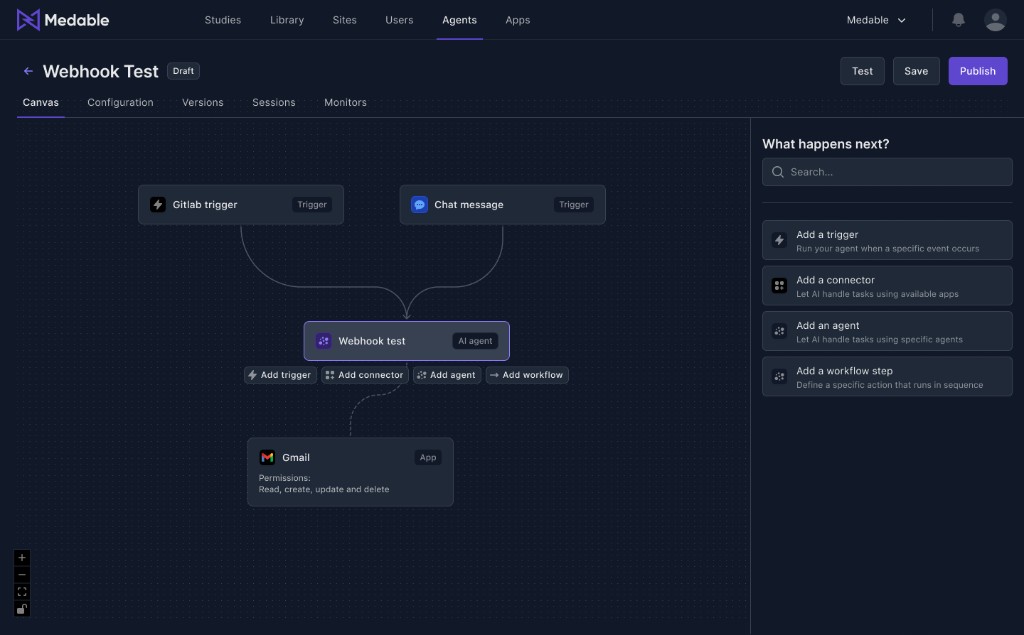
Clinical trials have outgrown manual workflows.
Trials are increasingly complex, but development still relies on manual, sequential processes and fragmented data. White space inefficiency compounds across 13+ platforms, strict compliance requirements that historically took years to implement, and a 95% failure rate for AI pilots in regulated industries.
- 95% of AI pilots fail to reach production in regulated industries
- CRAs manually navigate 13+ disconnected clinical systems daily
- Typical compliant AI builds take two years before anything ships
- 33% of CRA time lost to administrative stitching and reporting
- Sequential manual processes create white space inefficiency across trials
- No-code agentic AI platform purpose-built for clinical development
- Unified data integration across 13+ clinical and enterprise systems
- Production-grade agents deployed in weeks, not years
- Built-in GxP, ICH, HIPAA, GDPR, and CDISC compliance from day one
- Configurable autonomy with human-in-the-loop checkpoints
Constraints that shaped the work
Trust, not just capability
In a regulated clinical context, an agent that's powerful but unpredictable is worse than no agent at all. Every design decision had to answer how a human verifies an action before it runs.
A shared trust framework, applied across different risk profiles
The platform's guardrails, confidence indicators, and human-in-the-loop checkpoints were built to be reused across agents, which meant proving they held up against genuinely different workflows. CRA monitoring and eTMF document handling put different pressure on the same components.
No prior internal pattern
Nucleus had components for deterministic clinical workflows, not for latency, uncertainty, and correction. Extending it to support agentic UI (confidence indicators, agent dialogs, smart suggestions) was part of the work, not a given.
Design process
Grounding in where trust breaks down
Worked with ClinOps and compliance stakeholders, alongside the broader design team, to map exactly where human trust in an automated system breaks, against the specific reasons the 95% of AI pilots fail to reach production in regulated settings.
- ·Most failed pilots skip human-in-the-loop checkpoints until late in development, then retrofit them under compliance pressure
- ·Set a shared design principle with the team up front: every agent action needed a legible, reviewable trail before it shipped, not after
Designing autonomy as a spectrum, not a toggle
Rather than a binary agent-or-human model, the platform's trust components were designed around configurable autonomy, with human-in-the-loop checkpoints as first-class configuration, not a fallback.
- ·Applied this model to CRA Agent and eTMF Agent: risk-flagging needed a different checkpoint posture than document classification
- ·Designed guardrail configuration alongside each agent's core workflow so compliance posture is set at build time
Designing CRA Agent and eTMF Agent within that framework
CRA interviews pointed to 13+ disconnected systems as the biggest daily cost, which shaped CRA Agent's unified data view and proactive risk detection. eTMF Agent centered on classification accuracy where a wrong automated call has direct compliance consequences.
- ·Designed both agents end to end: workflow, UI, and confidence/checkpoint patterns specific to each
- ·Fed agent dialogs, confidence indicators, and smart suggestions back into Nucleus for reuse by other agents
Shipping in the repo
Worked directly in Cursor alongside engineering to move from design intent to production component code faster, particularly for agent monitoring, confidence-indicator, and chat interface patterns without an existing Nucleus precedent.
CRA Agent
One of the first agents launched on Agent Studio, and one of the two I was personally responsible for designing end to end. The CRA Agent removes bottlenecks in clinical research monitoring by unifying data across multiple systems and surfacing insights automatically.
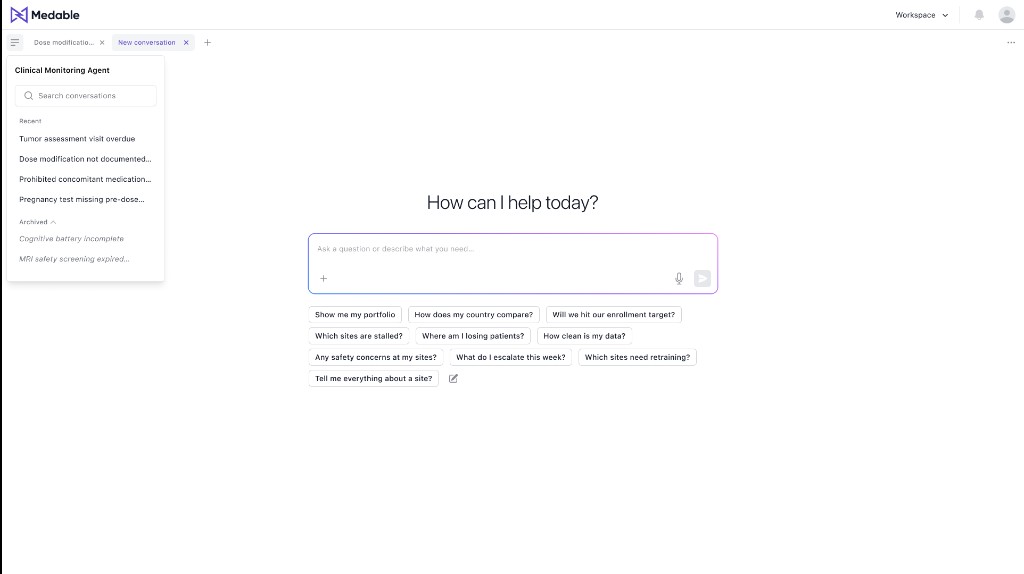
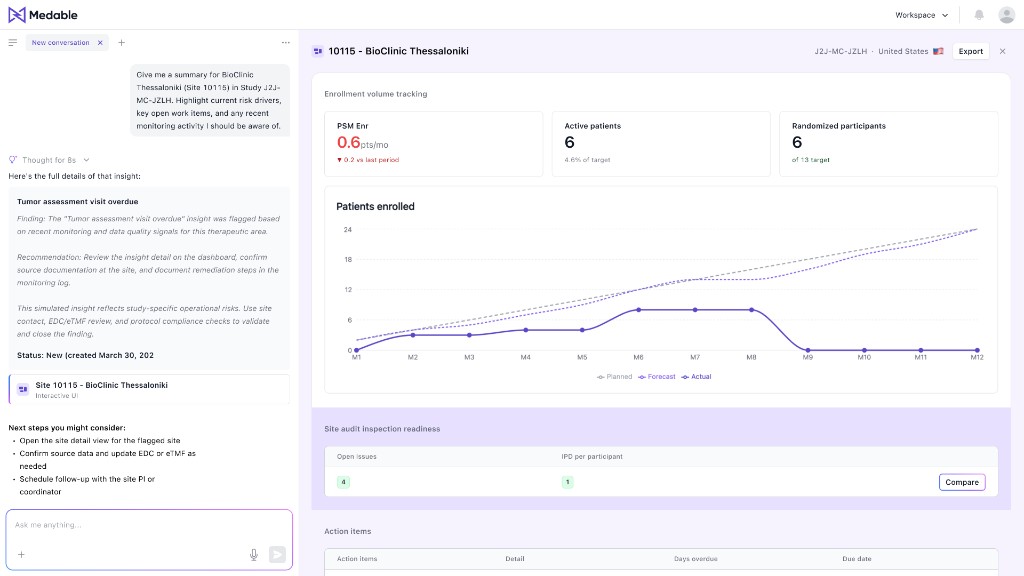
Unified data view
Automatically aggregates data from EDC, IRT, CTMS, eCOA, and other systems into a single interface. CRAs no longer spend hours logging into 13+ platforms.
Proactive risk detection
Identifies enrollment delays, protocol deviations, and data quality issues in real-time, with confidence indicators showing how much to trust a given flag before acting on it.
Automated report generation
Generates site visit reports, monitoring summaries, and compliance documentation automatically, with human-in-the-loop review built into the flow. Reduces CRA administrative burden by 33%.
eTMF Agent
The second agent I designed end to end, applying the same trust components to a document-classification workflow where accuracy and auditability matter more than speed.
Automated document classification
Classifies incoming trial master file documents against the required filing structure, reducing manual sorting.
Confidence-scored filing decisions
Every classification carries a visible confidence signal; low-confidence cases route to human review instead of being filed automatically.
Audit-ready by design
Every agent action is legible and traceable, built to hold up under the same compliance scrutiny as a manual filing process.
Platform capabilities
Platform-wide capabilities below reflect the full Agent Studio design and engineering team. CRA Agent and eTMF Agent, detailed in Headline work, are where I owned design end to end.
No-code agent builder
Deploy ready-to-go agents or create bespoke solutions without writing a single line of code.
Unified data integration
Seamlessly connect across 13+ clinical and enterprise systems to eliminate manual data stitching.
Built-in compliance
Purpose-built with GxP, ICH, HIPAA, GDPR, and CDISC compliance baked in from day one.
Flexible autonomy
Define how much control agents have with configurable guardrails and human-in-the-loop checkpoints.
Real-time insights
Agents surface critical insights and risks automatically, enabling faster decisions.
Rapid deployment
Launch production-grade agents in weeks, not years. No two-year build cycles.
Impact and results
Agent Studio is transforming how clinical development teams work, delivering measurable improvements in efficiency, speed, and outcomes.
Reflection
Two trust profiles, one system
Designing two agents with different trust profiles against the same shared component system is what taught me where the trust model needed to flex. A CRA flagging risk and an eTMF agent classifying documents do not call for the same kind of human double-check, and the confidence-indicator pattern only got good once I had designed it against both. I would loop eTMF compliance stakeholders in even earlier next time, since audit-trail requirements reshaped the classification UI after patterns from CRA Agent did not fully transfer.