Single App
Led a 0→1 redesign of participant onboarding, consolidating study-specific app versions into a single application and designing the end-to-end experience across iOS, Android, and web, cutting the engineering maintenance and testing burden that came with shipping a new app per study.
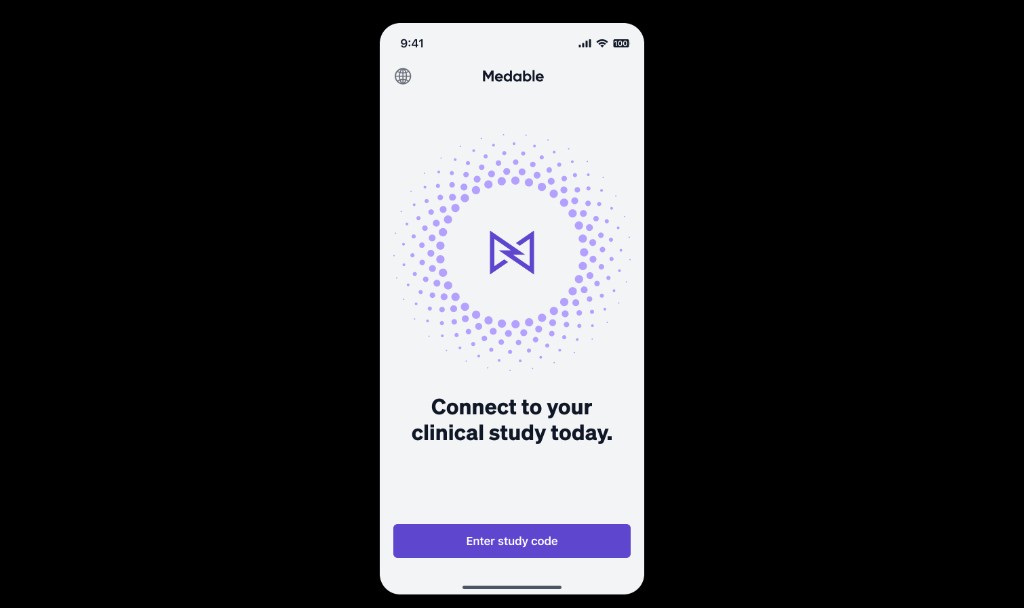
Every study shipped its own app. That doesn't scale.
Before this redesign, participant access was tied to org- and study-specific app builds. A patient enrolling in one trial downloaded a different app than a patient in another. Every study meant a new build, a new App Store submission, and a new surface for engineering to test and maintain indefinitely.
- Org-specific app versions multiplied with every new study, each requiring its own build, review, and release cycle
- Engineering carried the ongoing burden of testing and maintaining every version in parallel, even for studies that had wrapped
- Patients had to find and download the correct app for their specific trial, an avoidable point of confusion and drop-off before onboarding started
- Site staff had no consistent way to guide participants to the right access point across a growing catalog of app variants
- One Medable application in the App Store, for every study
- Participants access their trial with a study code and an invite code issued through Medable for Sites, with no study-specific download required
- A single onboarding flow designed once and shared across the site app and the patient app
- Engineering no longer builds, versions, or tests a new app per study
Constraints that shaped the work
In-flight trials could not break
The consolidation had to ship without disrupting participants already enrolled in studies running on the old per-study app model.
App Store review
Moving from many single-purpose apps to one multi-tenant app changes what the app is from a review standpoint, and the onboarding flow had to hold up under that scrutiny.
Security of the code-based access model
Study and invite codes needed to be secure enough to gate access to sensitive trial and health data without becoming a usability barrier for participants who are often not technical.
Design process
Audit of the existing app landscape
Catalogued every org-specific app version in market, mapping which onboarding steps were duplicated identically across all of them versus which varied by sponsor or study.
- ·Most onboarding logic was identical across app variants, with sponsor branding as the only meaningfully different layer
- ·Confirmed with engineering that parallel maintenance and QA scaled linearly with each new study
Designing the access model
Replaced download the app built for your study with download the one app, then prove you belong to your study, using study and invite codes issued through Medable for Sites.
- ·Worked through how codes are generated, distributed, validated, and expired without adding friction
- ·Mapped the handoff between site coordinator actions in Medable for Sites and the participant patient app experience
Cross-platform onboarding redesign
Designed the end-to-end onboarding experience once, then adapted it consistently across iOS, Android, and web, aligned with the shift to a single React codebase.
- ·Standardized the onboarding sequence so it behaves identically regardless of platform
- ·Worked with engineering on implementation feasibility given the shared React codebase effort
Validation
Tested the new code-based onboarding with participants unfamiliar with the old model to confirm the two-code entry point did not introduce new confusion in place of app-selection confusion.
Study code + invite code as the new front door
Instead of finding and downloading a study-specific app, a participant downloads the one Medable app and enters a study code and invite code issued by their site, collapsing what used to be an app-discovery problem into a simple, secure access step.
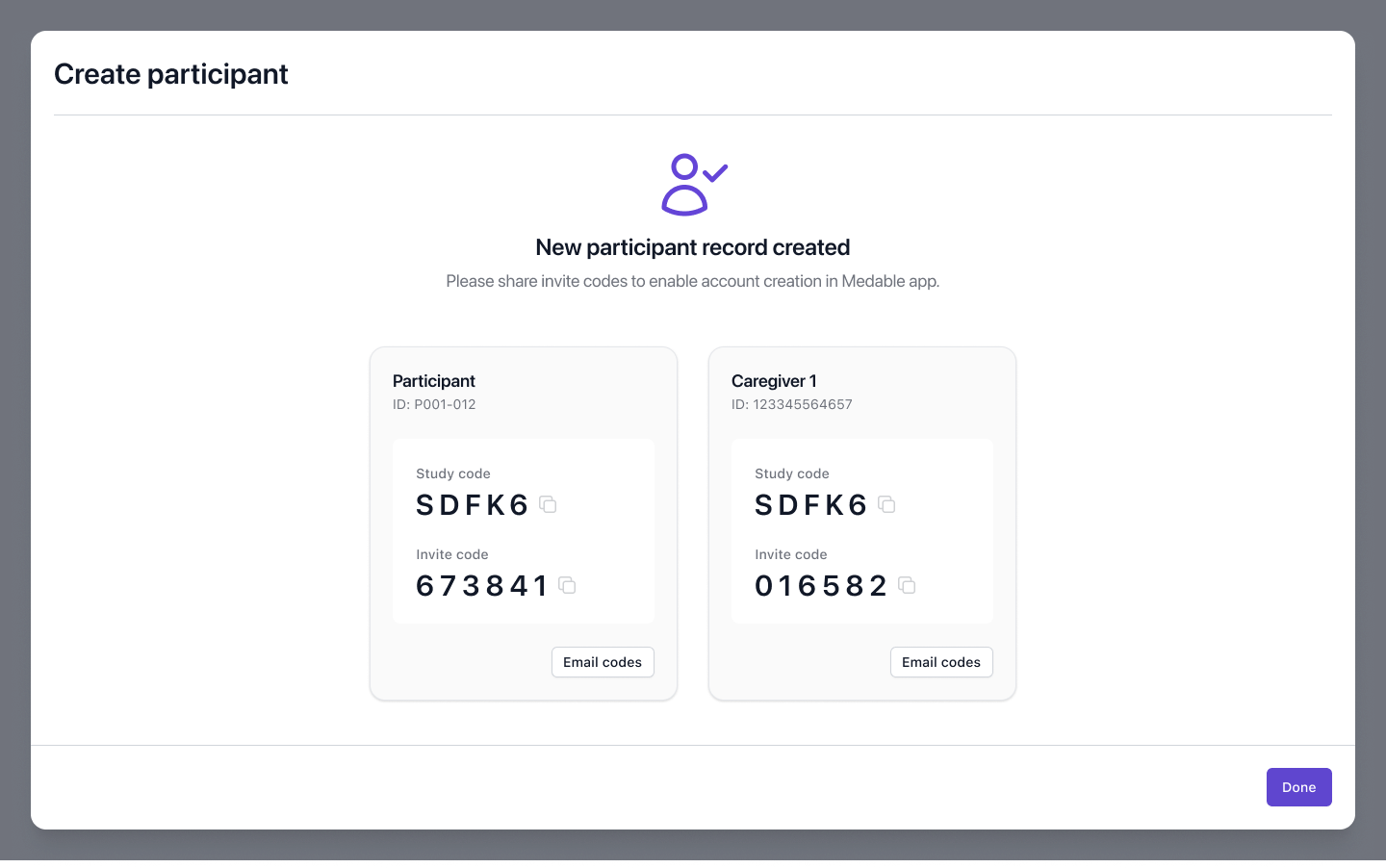
Site-issued access
Site coordinators generate and share study and invite codes directly through Medable for Sites, keeping enrollment control where it belongs.
One onboarding flow, every platform
The same onboarding sequence, rebuilt once against the shared React codebase, so iOS, Android, and web no longer drift apart in behavior or maintenance cost.
Impact
Consolidating to a single application shifted ongoing cost from N parallel codebases to one shared onboarding architecture.
Reflection
Reframing the problem
The design challenge was not the screens; it was reframing the problem from which app do I need to how do I prove I belong here. That reframe is what let engineering collapse N codebases into one. I would want harder data earlier on how much drop-off the old app-discovery step caused, to make the case for prioritizing this sooner.