Username Consent MVP
Led design for an MVP that let sponsors run email-based (PII) and username-based (No-PII) participant registration inside a single organization, replacing a dual-ORG architecture that doubled setup time, inflated compliance risk, and blocked competitive deals.
Every study needed two organizations. That was the bottleneck.
Medable required sponsors to stand up separate organizations for PII (email) and No-PII (username) participants on the same trial. Study builders duplicated configuration, coordinators saw fragmented registration flows, and sales lost deals to the operational overhead.
- Two organizations per study with duplicated study configuration and 2× setup time
- Fragmented participant registration and consent experiences across identity types
- PII and No-PII data managed in parallel systems, increasing HIPAA and GDPR exposure
- Dual-ORG complexity cited in lost competitive deals and ongoing platform maintenance debt
- One organization with configurable email, username, or hybrid registration
- Unified consent workflow that adapts to study identity settings
- Data segregation preserved inside a single ORG through role and boundary patterns
- Backward-compatible path for legacy dual-ORG studies during phased rollout
Constraints that shaped the work
Backward compatibility
Thousands of in-flight studies on dual-ORG architecture had to keep working while new studies adopted the unified model.
Data privacy by design
PII and No-PII could not commingle. Segregation had to be enforceable in UX, not only in backend policy.
Regulatory validation
Consent workflow changes required evidence for 21 CFR Part 11 and ICH-GCP, with audit trails study teams could defend.
Design process
Discovery and system mapping
Mapped registration, consent, and admin flows across sponsor, site, and participant experiences and documented HIPAA, GDPR, and 21 CFR Part 11 requirements with compliance and engineering.
- ·Interviewed study builders, compliance officers, and platform engineers
- ·Captured technical constraints for backward compatibility and migration
Stakeholder alignment on MVP scope
Facilitated workshops with Product, Engineering, Compliance, and Sales to sequence MVP touchpoints versus later phases and define success metrics.
Workflow design and prototyping
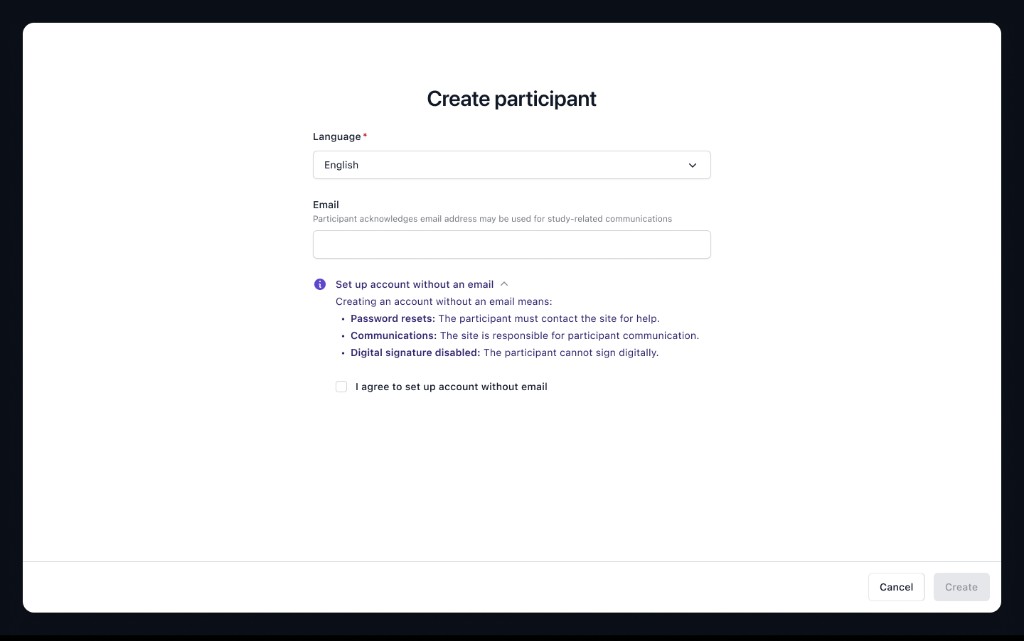
Designed configuration in Study Builder, site-facing create-participant flows, and participant registration for email and username paths.
- ·Prototyped username consent configuration and participant onboarding
- ·Usability testing with study builders on identity tradeoffs
Launch and iteration
Partnered through implementation QA, pilot rollout with sponsors, and iteration on edge cases, error handling, and training materials.
Unified identity inside one organization
Study builders choose how participants register; sites create participants once; participants see a single consent experience that respects the study's identity model, without standing up a second ORG.
Flexible identity configuration
Sponsors enable email, username, or both within one organization instead of cloning studies across two ORGs.
Unified consent workflow
One registration and consent path that adapts to study settings while keeping PII and No-PII boundaries explicit.
Cross-platform patterns
Reusable identity, validation, and consent components propagated across Study Builder, portals, and admin tools.
Impact
The MVP removed duplicate ORG setup from the critical path for new studies and gave sales a simpler story for regulated identity models.
Reflection
Mental models before mockups
Study builders needed decision support for email versus username consent, not just toggles. Contextual help and guided configuration reduced misconfiguration more than additional screens.
Compliance as a design partner
Partnering with Compliance through validation evidence, not at the end of the flow, kept audit-trail requirements from reshaping the UI late in the program.